For production companies, advertising agencies and XR studios
You choose the studio. We bring the XR volume, the kit around it and the crew.
A 200 m² Absen volume - curved or straight - with the full signal chain a camera needs and a crew that stays on set every shooting day. We work at the Solent and Boyana studios and wherever the production decides.
- Louis Vuitton
- Range Rover
- Siemens
- BritBox
- L’Oréal
The volume comes to the production, not the other way round
The usual XR model in Bulgaria: the screen is permanently installed in one studio, with one radius and one size. The production adapts to it - the set design, the camera, the schedule.
We work the opposite way. The screen, the kit around it and the crew are ours; the studio is your choice. Solent’s studios already have our dimensions, we work regularly at Boyana, and if the production is somewhere else, we come to it. The radius, length and height of the volume are decided for your shot, not the last one.
That is why studios hire us too - when their production needs a volume their permanent installation cannot give them.
And the reverse: if the production comes with its own camera operator, its own camera or its own render team, that is fine with us. We don’t make anyone work only with our equipment. The volume and the chain fit into what you already have.


Two volumes, one brand
| Absen Flexible 1.8 | Absen Flat 2.6 | |
|---|---|---|
| Area | 200 m² | 200 m² |
| Shape | Curved - smoothly, up to 45° per cabinet, min. Ø 1.27 m, no kinks | Straight or curved - faceted (flat cabinets, a kink every ~50 cm) |
| Best for | Close-ups, cosmetics, a face at 1.5-2 m | Wide and medium shots, cars, stage |
| Protection | GOB - coated LEDs | - |
| Proven on | L’Oréal | Louis Vuitton, Range Rover, Siemens, BritBox |
Ceiling: P4.8 or P6.6 - for reflections and top light when the shot needs it.
Tracking: we provide it for the production when needed.

The signal chain
The screen is half the job. The other half is whether the picture on it is in sync with the shutter, accurate in colour and stable at 250 fps. We arrive with the whole chain:
See the whole chain
Picture
- 7680 Hz refresh rate
- 8/10/12-bit colour depth, Infi-bit and grayscale refinement
- HDR10 / HLG
- Frame rate 23.976-250 Hz
- Colour management: colour curves, Color Magic, 3D LUT
- ShutterLock and Genlock
Sync
- Evertz master clock - 6 independent genlock outputs, locks different standards together as one; two timecode generators
Render
- 3× Lenovo workstations - Unreal nDisplay nodes or artist stations, Quadro Genlock
- 3× render stations for Unreal nDisplay / Vertex / Smode / Pixera, Quadro Genlock
- 8K I/O cards in every station
Network
- 20 Gb to every node
- Perforce version control server, 50 Gb link
- 16 TB server, 100 Gb uplink
Software
- Ventuz · Smode · Photon (our own media server) · Notch · Resolume Arena
Also
- SDI routing and distribution as needed
- Software development for the job
- Calibrated reference monitors: 40″ LG HDR (sRGB 99%, DCI-P3, ΔE 2) · 40″ Dell U (sRGB 99%, DCI-P3, ΔE 1.2)
- Post-production, live playout and control
Five productions, five international brands
| Client | Volume |
|---|---|
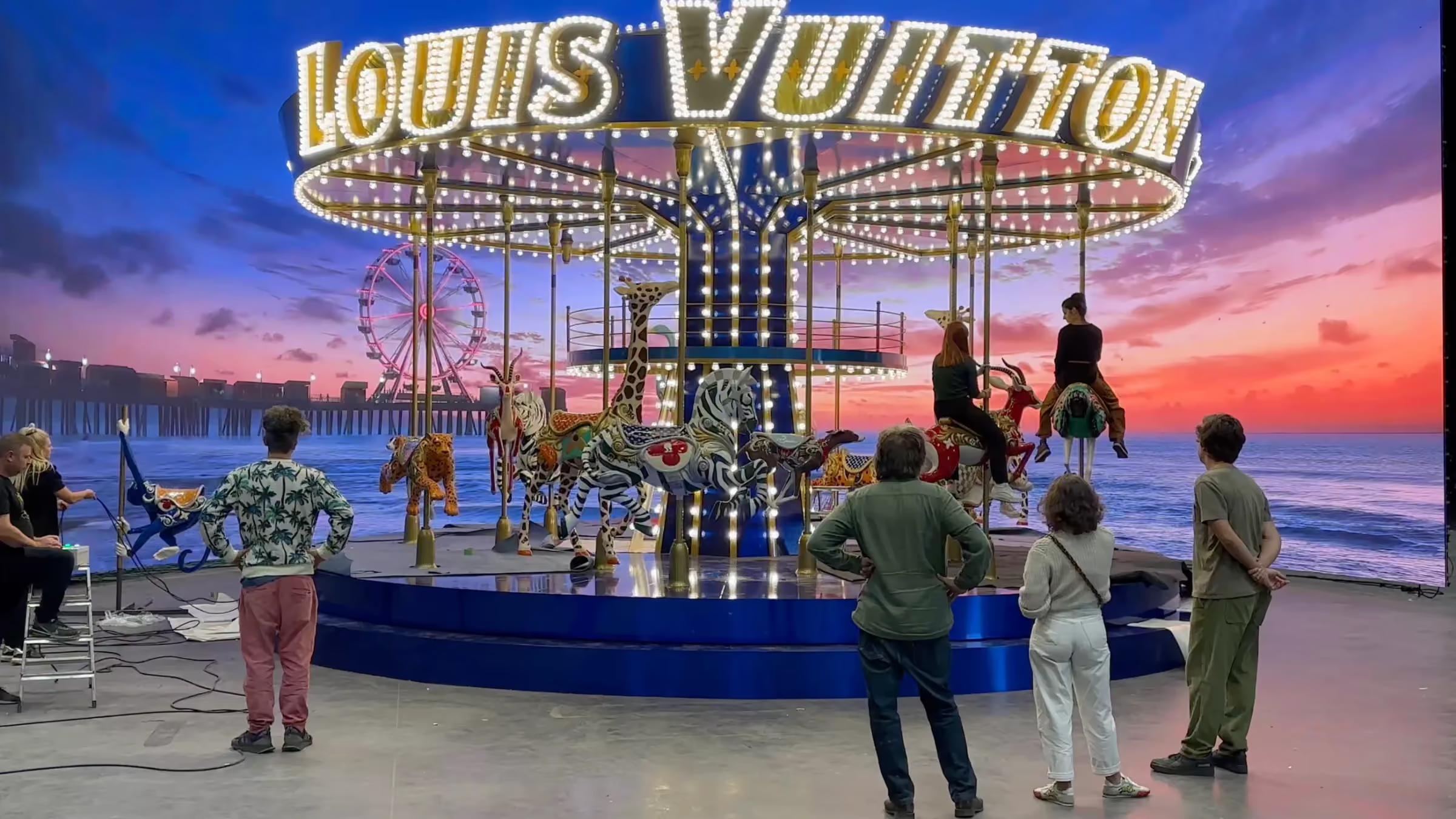
| Louis Vuitton | 200 m² Flat 2.6, curved volume |
| Range Rover | 192 m² Flat 2.6, curved volume |
| Siemens | 135 m² Flat 2.6, curved volume |
| BritBox | 100 m² Flat 2.6, curved volume |
| L’Oréal | 100 m² Flexible 1.8, curved volume |
A luxury, an automotive, an industrial, a television and a cosmetics brand. Five different cameras and five different sets of requirements - the same crew behind the volume.
Range Rover - the ceiling that moves. The brief was not just a wall with a ceiling. The whole LED ceiling had to move ±10 m left and right, and forwards and back, between shots - the walls stay static, only the ceiling moves. We did it. On set we also helped with the colour correction, so that the British crew saw on the monitor what they wanted, not what the screen could do.

The language at the desk. Producers and directors speak a language of their own - “warmer”, “a deeper sky”, “no flicker at this shutter”. The difference between a supplier and a crew is whether the person at the desk understands what they are told and does it while the director watches the monitor. Our people understand it. That is why we stay on set, not in the truck.
The same volume and the same crew also shoot commercials for the Bulgarian market. The difference between an international and a local production is the budget, not what shows up on the monitor. What the director approves on set is the shot.


The call at 18:30
An international production in a Bulgarian studio. The hired supplier’s quote says pitch 1.9. What arrives on set is 2.9. The camera sees the pixels, and the producer wants settings the crew at the desk cannot deliver. The crew has flown in, the studio is paid for, and there is no postponing.
The call came at 18:30, at the end of the working day. Our desk operator was on a job at the other end of the country. That evening we put him on a flight to Sofia - not on an overnight drive, because in the morning we needed a rested person at the desk, not an exhausted one. The crew set off with the Flexible 1.8 cases and our control desks. At 7:00 he was on site and set up. The plan: we take over control of the existing screen; if the producer is not happy by 11:00, we rebuild. At 11:00 the producer was looking on camera at what they had asked for. The rebuild was not needed. The remaining shooting days ran to schedule.
The screen was the same. The difference was who sat at the desk.
We don’t say who or where - it is not our story to tell. We tell it for two reasons: from an evening call to a satisfied producer before noon the next day, and one piece of advice - before the shoot, ask to see the pitch on camera, not in the quote.

Days of use
Large productions follow one schedule: build, 2-3 days of prelight, 2-3 shooting days, de-rig. You pay for the prelight and the shoot. The build, calibration and de-rig are not counted.
Each further day costs less than the one before - a five-day production does not cost five single days.
The price comes after the brief. A volume with a curve, a ceiling, rendering and a schedule cannot be worked out with four fields; the brief takes three minutes and we reply within 24 hours.
The difference
| When the shot is fitted to the wall | When the wall is built for the shot |
|---|---|
| One radius, one size - the set design works around it | Radius, length and height - decided for your shot |
| The kit around the screen - to be negotiated | Screen, signal chain, rendering and software - one responsibility |
| Equipment and crew - fixed | Your camera, your camera operator, your render team |
| Ceiling and movement - whatever is available | P4.8 / P6.6 ceiling that moves between shots |
| “We do XR too” | Louis Vuitton, Range Rover, Siemens, BritBox, L’Oréal - by name |
Questions about XR
How big is the volume?
Up to 200 m² Absen Flexible 1.8 or 200 m² Absen Flat 2.6, plus a P4.8 / P6.6 ceiling.
Which pitch for close-ups?
1.8 with the lens at 1.5-2 m. For wide and medium shots, 2.6 is enough.
Which studio?
The one the production chooses. We work regularly at Solent and at Boyana; our dimensions are known there. Another location - we can discuss it.
Can we bring our own camera operator, camera or render team?
Yes. We don’t require the production to use only our equipment. The volume and the signal chain fit into the crew you already have.
Do you provide tracking and rendering?
Rendering - yes, with Unreal nDisplay nodes and the full signal chain. Tracking we provide for the production when needed.
Is there a technician at the shoot?
Yes, every day from prelight to the end. Spare modules, a processor and power are on set.
How is it charged?
By days of use - prelight and shooting. Build, calibration and de-rig are not counted.
Why XR instead of green screen?
With green screen the director sees the result in post - weeks later. With XR they see it on the monitor during the shoot: real reflections, real light on the subject, an actor looking at an environment instead of a green sheet. What they approve on set is the shot.
Why is there no calculator?
A volume with a curve, a ceiling, rendering and a schedule cannot be worked out with four fields. Brief - three minutes; reply - within 24 hours.
Send your production brief
Thank you! Your brief has been sent - we'll get back to you.